Thursday, October 2, 2014
A Quick Look: Some Features of Mannerism
The word mannerism hails from the Italian, maniera, meaning style, or stylish, and is generally thought to have followed the period of High Renaissance art, and immediately preceded the Baroque period.
The early 16th century was a time of political upheaval and change in Europe. Martin Luther was forging the way for the Reformation and the Catholic Church was beginning to lose it's foothold in Europe. The 1527 Sacking of Rome, an invasion of Habsburg troops, caused many artists there at the time, to abandon Rome and head for other parts of Italy or Europe. The new style, now called Mannerism, began to spread through the princely courts of Italy, but was prominent in Florence, and in Florentine artists (Janson's pg. 346, 347).
While the Renaissance focused on naturalism and humanism in art, Dr. Beth Harris and Dr. Steven Zucker mention, in a KhanAcademy video (see url below, Sources), when discussing Mannerist artist, Parmigianino, Mannerism vaulted in the opposite direction, distorting images and emotions to underline and complicate elegance and the human form.
Below is an example, Parmigianino's "Madonna of the Long Neck", (ca. 1530-33)
We can see some distinct distortions at play, in the Madonna above... as the title suggests, her neck IS very long, in addition, her head is quite small, in proportion to her body, which is very voluptuous, with more than ample enough lap, to hold the over-sized body, of the Christ Child. Just touching on a couple of aspects of the use of distortion in this work, while there is no denying the beauty of the subjects, the bodies and parts of the bodies are very unrealistic, in proportion to each other. In terms of emotion, despite the fact that it looks as though the Madonna is possibly holding a dead Christ Child, the look on her face conveys, not a sense of outrage or intense grief, but rather, she looks quite serene, almost satisfied with the situation. The subjects are not reacting in a realistic way, to the scene they are in.
Mannerism seems to have very consciously moved away from the Renaissance and it's portrayal of reality in it's natural state, and began to explore the human form and it's surroundings, in a more idealized, dramatic way.
Above is a painting by Florentine artist, Agnolo Bronzino, ca. 1545., Eleonora di Toledo with Her Giovanni. The portrait was is of the wife and son of Cosimo Medici, of the Florentine Medici Dynasty. Here is a portrait of a mother with her son, yet it is totally devoid of any emotion that we imagine, would dominate that relationship, like, for example, love. Rather, here is a woman, aloof and cold, whose posture reflects a strictness that is almost alarming. The child is noticeably detached from her, they do not seem to be together, yet they are physically touching. They are too perfect, almost inhuman, yet simultaneously beautiful to look at. The juxtaposition of the subject matter and the result are very heavy. We often think of portraits being commissioned not only to commemorate someone, but to immortalize them, in a way that photographs and film do now. It is unlikely that this is a realistic portrayal of the subjects, but I doubt it would have survived, if it had not been wholeheartedly approved of, by Cosimo Medici, who commissioned the work, or his wife. You might say, Mannerism was, at times, a bit like the PhotoShop of the 16th Century!
Sources
http://smarthistory.khanacademy.org/parmigianinos-madonna-of-the-long-neck.html
http://smarthistory.khanacademy.org/bronzino-portrait-of-eleonora-di-toledo-with-her-giovanni.html
http://www.visual-arts-cork.com/history-of-art/mannerism.htm#definition
Janson's Basic History of Western Art, Eighth Edition, copyright 2009, Pearson Education Ltd.,
pgs. 346, 347, 357
Tuesday, September 30, 2014
Imitation and Emulation in Renaissance Art
The idea that a great artist is someone who has meticulously and persistently, copied the ideas and works of another artist, may seem strange to most 21st century minds. In contemporary western society, we place a great deal of importance, seemingly, on originality and uniqueness, in the world of visual art. However, all art is evocative on some level, of something that has come before, and originality can be as subjective as the art itself.
In Gardener's text, Art Through the Ages: A Western Perspective, we are given an excerpt from Cennino Cennini's The Artist's Handbook, published in 1400 CE (pg. 431). Cennini strongly encourages the young artist to seek out the best and most successful artists and art available to them, and set to work copying their form and style, over and over, until perfect duplication of the work is achieved. At the same time, he suggests the young apprentice focus on one artist or work at a time, that to try and learn too much at once, will only detract from the ultimate goal, of perfecting the craft. Cennini insists that through dedicated and repetitive imitation and emulation of works of art that inspire, one will eventually be skilled enough, to reveal his own style.
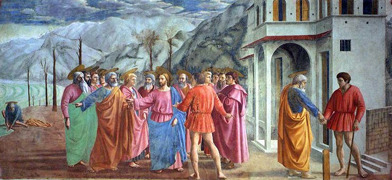
In Gardener's text, we have an example regarding early Italian Renaissance painter, Masaccio, born Tommaso di Ser Giovanni di Simone, stating that, 'most art historians agree, "... no other painter in history has contributed so much to the development of a new style in so short a time..."' (pg.432). Masaccio's Tribute Money, a fresco painted in Santa Maria del Carmine, in Florence, Italy, for the Brancacci family chapel, ca. 1424 – 1427 CE, is a beautiful example of imitation and emulation, resulting in a unique style and innovation. In this painting, shown below, Masaccio draws on influences from other artists.
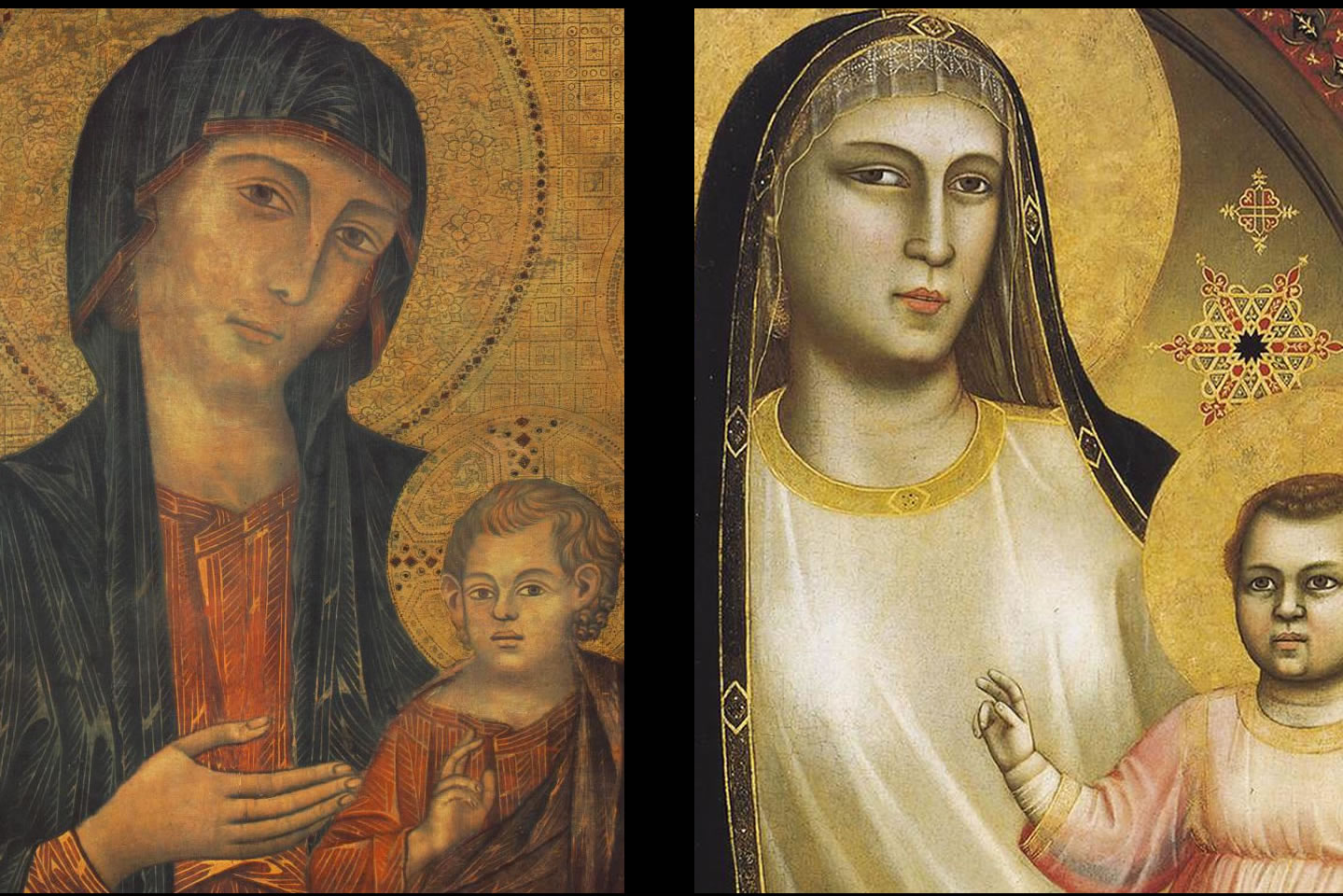
Giotto di Bondone is widely considered to be the first, true Renaissance artist. Giotto approached his subject matter in a more natural manner than many of his contemporaries, as in his "Madonna Enthroned", ca. 1310 CE. When we compare it to Cimabue's Madonna, painted ca. 1280-1285 CE, we see that Giotto, who was a student of Cimabue, has taken the skills and knowledge passed on to him by his master, and parlayed it into something new and exciting, treading carefully away from the Byzantine, one dimensional approach. Giotto's Madonna and Child have a more human, grounded quality, he focuses more on the individual subject and her qualities, for example, the way her body is influencing the play of her robes, rather than the other way around. When we experience the human form in "Tribute Money" we can see elements of Giotto in the faces and bodies of Jesus and his disciples... they are very human, emotional, in the moment of the scene. As Giotto strove to import a more realistic perspective in his paintings, Masaccio takes it a step further.
Cimabue Giotto
Another important influence on Masaccio's fresco "The Tribute Money", is the Florentine architect and innovator, Filippo Brunelleschi, the man credited with the Renaissance development of linear perspective, ca. 1420 CE. In short, he demonstrated that with a fixed single point of view, parallel lines appear to converge at a single point in the distance. The people and things Masaccio painted in "The Tribute Money" possess a realistic, spatial relationship to one another, and as a spectator, we are almost in the scene, we feel we are seeing it as we would, had we been there.
The figures in "The Tribute Money" fresco are also influenced by contrapposto, where the standing human figures weight is distributed unevenly, much of the weight resting on one foot, helping to convey a sense of emotion, movement or relaxed body language. Donatello, born Donato di Niccolo Bardi, created St. Mark at Orsanmichele in Florence, sculpted in marble ca. 1411 - 1413, shown below, one of the earliest examples of the implementation of contrapposto in Renaissance art. While Donatello was influenced by Brunelleschi, he was also influenced by Greek and Roman works from classical antiquity, and in Masaccio's painting above, we clearly see his use of contrapposto, giving his figures a sense of vibrancy and movement.
Ceninni's advice to budding young artists to employ imitation and emulation as springboards in learning the crafts of painting and sculpture, is spot on, and we can observe some of the the trickle-down effect of it's influence, in the Florentine, early Renaissance artists, discussed above. The result is a more and more refined and realized style, that continues to inform artists today. We must remind ourselves that six or seven hundred years ago, artists were more like craftsmen - rarely, if ever, making art for themselves, or for the simple pleasure of it. Most works were commissioned by the wealthy elite, and the content was, commonly, very specifically, dictated by the patron of the commissioned work. Materials were far too dear, and it was more important for an artist to be working and earning a living, than to produce something that no one had ever seen before. Originality and uniqueness were not the goal of the early Renaissance artist, rather, the main goal might have simply been, perfecting your skills, striving to being the best at your craft, and earning the chance to continue doing it.
Source: Gardener's Art Through the Ages: A Western Perspective, Vol., 2, 13th Ed., by Fred Kleiner, Cenage Learning, Copyright 2009, Pgs., 425, 431, 432
Subscribe to:
Posts (Atom)